On this page
- ISMS meaning: what does ISMS stand for?
- What is an information security management system?
- What is the difference between an ISMS, ISO 27001 and security tools?
- What does ISO 27001:2022 require of an ISMS?
- ISMS documentation
- How do you build an ISMS?
- How is an ISMS audited and certified?
- What are the most common ISMS mistakes?
- How does an ISMS support GDPR, PCI DSS and Cyber Essentials?
- Why Sovereign Secure?
- Next step
An information security management system (ISMS) is the set of policies, processes, people and controls an organisation uses to manage risks to the confidentiality, integrity and availability of its information. ISO/IEC 27001:2022 is the international standard for an ISMS: it sets out what the management system must do in clauses 4 to 10, and lists 93 Annex A controls to choose from based on your risks. An ISMS isn’t software you buy. It is the way you plan, run, check and improve security, with leadership accountable for it.
Most organisations already have security tools: firewalls, anti-malware, backups, a password policy. What many lack is a way to decide which controls they need, check those controls keep working and prove it to customers. This guide explains how an ISMS does that, what ISO 27001 requires, and how to build one that works in practice. If you are new to the standard itself, start with our guide to what ISO 27001 is.
ISMS meaning: what does ISMS stand for?
ISMS stands for information security management system. It means the documented, risk-based way an organisation protects its information: the policies, risk assessments, controls, roles, audits and reviews that leadership owns and improves over time. An ISMS can be independently certified against ISO/IEC 27001, the international standard that defines what one must include.
Key takeaways
- An ISMS manages information security risk through people, processes and technology together.
- ISO/IEC 27001:2022 is the standard an ISMS is certified against; the 2013 transition ended on 31 October 2025.
- Risk assessment drives everything: controls are chosen to treat the risks you identify.
- ISO 27001 makes a defined set of documents and records mandatory.
- Internal audit, management review and continual improvement keep the ISMS alive after certification.
What is an information security management system?
An ISMS covers three things:
- People: roles, responsibilities, awareness and competence.
- Processes: risk assessment, change management, incident response, supplier management and audit.
- Technology: the technical controls that protect systems and data.
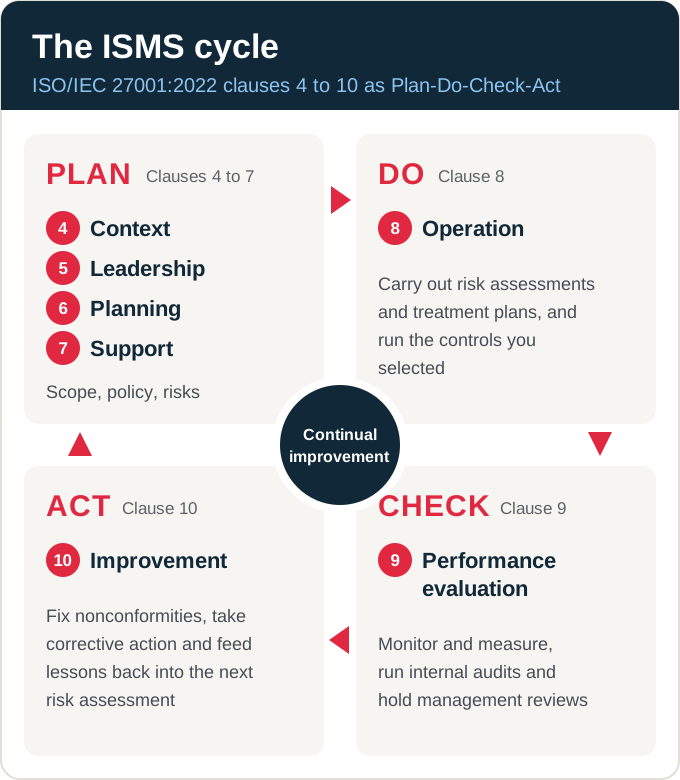
The key word is management. An ISMS is a set of decisions, records and routines, owned by leadership, that make sure security is planned, implemented, checked and improved. It follows a Plan-Do-Check-Act cycle, so it adapts as your risks change.
How does the ISMS cycle map to ISO 27001?
ISO/IEC 27001:2022 does not use the term Plan-Do-Check-Act, but its clauses follow the same cycle:
- Plan (clauses 4 to 7): understand your context and scope, set the policy and roles, assess and plan the treatment of risks, and put the resources, skills and documents in place.
- Do (clause 8): carry out the risk assessments and treatment plans, and run the controls.
- Check (clause 9): monitor and measure, run internal audits and hold management reviews.
- Act (clause 10): fix nonconformities and improve continually, feeding lessons into the next round of planning.
What is the difference between an ISMS, ISO 27001 and security tools?
| Aspect | What it is | Example |
|---|---|---|
| Security tools | Individual controls | Firewall, endpoint protection, backup software |
| ISMS | The system that decides which controls you need and checks they work | Your risk register, policies, owners, audits and reviews |
| ISO/IEC 27001 | The standard that defines what an ISMS must include | The requirements an auditor certifies you against |
Without an ISMS, organisations tend to buy tools in response to the latest incident or sales pitch, leave gaps that no tool covers (supplier security, leavers’ access) and struggle to show customers a coherent picture. With one, every control traces back to a risk and forward to evidence that it operates.
Technical baselines still matter. Cyber Essentials certifies five technical controls that fit naturally inside an ISMS, and our comparison of Cyber Essentials vs ISO 27001 explains how the two work together.
What does ISO 27001:2022 require of an ISMS?
The main body of ISO/IEC 27001:2022 sets out seven clauses. Every one is mandatory for certification:
| Clause | What it requires | Typical evidence |
|---|---|---|
| 4 Context | Understand the organisation, interested parties and the ISMS scope | Scope statement, list of interested parties and their requirements |
| 5 Leadership | Top management commitment, a security policy, assigned roles | Signed policy, role descriptions |
| 6 Planning | Risk assessment, risk treatment, security objectives, planned changes | Risk method, risk register, Statement of Applicability, objectives |
| 7 Support | Resources, competence, awareness, communication, documented information | Training records, document control |
| 8 Operation | Carry out risk assessments and treatment plans | Updated risk results, operating records |
| 9 Performance evaluation | Monitoring, internal audit, management review | Metrics, audit reports, review minutes |
| 10 Improvement | Handle nonconformities and improve continually | Corrective action log |
Annex A lists 93 controls in four themes: organisational (37), people (8), physical (14) and technological (34). You don’t have to implement every control. You decide which are needed to treat your risks and record the decision, with justification for any exclusions, in a Statement of Applicability. ISO/IEC 27002 gives guidance on implementing each control, and our guide to ISO 27001 controls explains each one in plain English.
ISMS documentation
An auditor will ask to see a defined set of documents and records, from the ISMS scope, information security policy and Statement of Applicability to internal audit and management review results, and applicable Annex A controls can call for more. The full list, clause by clause, is on our ISO 27001 requirements page, and our ISO 27001 checklist lets you check your ISMS line by line.
How do you build an ISMS?
- Get leadership commitment. Agree why you are doing it (customer demand, risk reduction or both) and who at board level is accountable. An ISMS run by one person without senior backing becomes a paperwork exercise.
- Define the scope. Decide which parts of the organisation, locations, systems and services the ISMS covers. A narrow scope is quicker to certify, but customers will check that it covers what they buy.
- Assess risks. Identify information assets, threats and vulnerabilities, and assess likelihood and impact with a consistent method. Involve the business, not just IT; many big risks sit in processes and suppliers. Our guide to ISO 27001 risk assessment includes a free risk register template, and some organisations borrow from the NIST Risk Management Framework for their method.
- Treat the risks. For each significant risk, decide whether to reduce, avoid, transfer or accept it. Select controls, record them in the Statement of Applicability and assign owners.
- Implement controls and write what you need. Policies and procedures should describe what people actually do. Train staff on the parts that affect them.
- Measure, audit and review. Check controls work through access reviews, vulnerability scanning and incident metrics. Run an internal audit across the ISMS, then a management review where leadership decides on improvements.
- Certify. An independent certification body audits you in two stages.
If you are starting from scratch, an ISO 27001 gap analysis shows how far you are from the standard and gives you a prioritised plan. For the full phase-by-phase plan and realistic timelines, see our guide to ISO 27001 implementation.
How is an ISMS audited and certified?
Before certification you need at least one full cycle of internal audit and management review. The ISO 27001 internal audit must be carried out by someone objective and competent, and its findings must be acted on.
Certification then happens in two stages. Stage 1 reviews your documentation and readiness. Stage 2 tests whether the ISMS operates as described, through interviews, sampling and observation. The certificate lasts three years, with surveillance audits in years two and three and a recertification audit before expiry. Our guide to the ISO 27001 audit explains what happens at each stage, and our ISO 27001 certification cost guide sets out the fees.
What are the most common ISMS mistakes?
- Treating it as an IT project. Many risks sit in HR, finance, suppliers and facilities.
- Documentation without practice. Auditors look for evidence that what is written actually happens.
- A risk assessment done once. Risks must be reassessed at planned intervals and when significant changes occur.
- Ignoring suppliers. Cloud providers and outsourced IT often hold your most sensitive data.
- No measures. Without metrics, a management review has nothing to review.
- Over-building. A 30-person firm with a bank’s policy set will struggle to follow its own rules.
How does an ISMS support GDPR, PCI DSS and Cyber Essentials?
An ISMS provides the governance that other requirements rely on:
- UK GDPR: Article 32 requires appropriate security for personal data, including regular testing of its effectiveness. An ISMS gives you a structured way to show this. Our guide to GDPR compliance audits covers the privacy-specific parts an ISMS doesn’t.
- PCI DSS: risk analysis, policies, incident response, supplier management and training all overlap with PCI DSS Requirement 12. The ISMS doesn’t replace a PCI DSS assessment, but it makes compliance easier to sustain.
- Cyber Essentials: the five technical controls map to Annex A controls on configuration, malware, vulnerability management and access control.
The organisations that get most from ISO 27001 use the ISMS to make real decisions about security spending and priorities, not just to pass the next audit. Our article on the benefits of ISO 27001 sets out what they typically gain.
Why Sovereign Secure?
We run our own ISMS and are ISO 27001 certified, so we build systems we would be happy to be audited against. As a PCI SSC Qualified Security Assessor (QSA) company and an IASME-licensed Cyber Essentials certification body, we also map ISMS evidence across PCI DSS and Cyber Essentials. Certification audits are carried out by an independent certification body, our partner MQA International.
Next step
Our ISO 27001 consultancy covers gap analysis, ISMS implementation and internal audit, with certification audits by MQA International, an independent certification body. If you are comparing providers first, our guide on how to choose an ISO 27001 consultant sets out the questions to ask.
Free tools and services
- ISO 27001 checklistClause-by-clause readiness and a Stage 1 and Stage 2 audit checklist, free in Excel.Get the checklist
- Statement of Applicability templateAll 93 Annex A controls in a free spreadsheet, with a worked example.Get the SoA template
- Get an ISO quoteConsultancy from an ISO 27001-certified firm, with audits through our partner certification body, MQA International.Get an ISO quote